Thursday, February 24, 2011

Today we had a blind pug come into work which is not unusual at all. Very often we have blind dogs come in for grooming but most of the time they are on the older side and their sight has been taken from them due to their age. However, there are cases in which canines simply go blind suddenly, often because of SARDS (Sudden Acquired Retinal Degeneration Syndrome). When a dog goes blind it is often seen to be harder on the owner than on the dog him/herself.A dog's sight is number three on the list of senses, after smell and hearing. When we look at it this way, it almost seems a lot more manageable for a dog to accept his/her blindness. We often struggle more, imagining what it would be like for a human to go through something as terrible as sudden blindness.

I looked up some tips to help owners with blind to manage and to more importantly, help their pets manage:
  1. Try not to move furniture around or leave obstacles on the floor.
  2. Remember we take things so much harder than they do and they also pick up on our emotions.  So try to express  "happy" emotions around your blind baby
  3. Emphasize the senses they still have:
    A blind dog/pup-their sense of smell, hearing, taste and touch
    A blind/deaf dog-their sense of smell, taste and touch (they can feel vibrations-especially when you walk)
  4. Ask people to let your dog "smell" their hand before touching them.  Most blind dogs personalities don't change. Some dogs however can easily become "startled" and this could  also lead to fear biting in some dogs.  
  5. Try to treat them as normal as possible.  Building their confidence is key to letting them know they can still do things and that you still love them....let them know they are still the same  dog in your eyes.  For a blind pup it can be the basis for what type of personality they will developed.  
  6. Coax, encourage and praise them to do the same things they did before.  However, understand and still praise them if they "can't".  
  7. Be creative with different scents to mark areas for your blind babies--just make sure its safe for them.  You can use different scents of flavored extracts or even something as simple as hanging a car air freshener or potpourri sachet on a door.  Using different scented candles in each room may also help your dog distinguish from different rooms in your house
  8. Use textured materials to mark areas. Throw rugs and decorative pillows are great (and people don't even realize their "Real" purpose). Indoor/outdoor carpeting, wind chimes and something as simple as cedar chips or decorative bricks or blocks can help guide them along their way outside. 
  9. Use bells or jingling tags on your other dogs.. not only help your blind babies to find/follow  your other dogs, but will also avoid them from being startled by your other dogs.  You can also use bells on your shoes to help them find you
  10.  Don't be afraid to walk with a "heavy foot" when approaching them especially with a blind/deaf baby....they can still feel vibrations. 
  11. Don't under estimate the power of touching and massage. 
  12. Be very vocal with your dog.
  13. A tabletop fountain can be used as a water bowl. Get a simple one with a large bowl and the sound of running water helps to orient the blind dog and helps him to find his water bowl as well as know where he is from the sound. Some dogs like drinking from running water too! This can be especially helpful if you have to move to a new home with a blind dog.

Poem about a Blind Dog 
by Sherrill Wardrip

I cannot see you Mommy, when you cuddle me so near.
And yet I know you love me, it's in the words I hear.
I cannot see you Daddy, when you hold me by your side
But still I know you love me when you tell me so with pride.

I cannot see to run and play out in the sun so bright
For here inside my tiny head it's always dark as night.
I cannot see the treats you give when I am extra good
But I can wag my tail in Thanks just like a good dog should.

"She cannot see. The dogs no good" is what some folks might say
"She can't be trained, she'll never learn She must be put away."
But not you, Mom and Daddy You know that it's all right
Because I love you just as much as any dog with sight.

You took me in, you gave me love and we will never part
Because I'm blind with just my eyes, I see you in my heart. 

Monday, February 21, 2011

Puppies Do Bite Back


As discussed in my previous post, puppies are born with certain genes that cause them to behave in certain ways. Dogs explore everything with their mouths, puppies especially love to get a taste of anything they can get their little paws on. This often becomes an issue when they begin to chew your belongings our even worse, when they start to bite humans. When puppies play with one another, biting and nibbling is a very big part of this. However, sometimes the biting gets too rough and one of them will cry out in a yelping manner to make it known that the biting has gone too far. This same method can be used with puppies and humans.

When a puppy bites a human too hard, make it known by crying out just as a puppy might. If this does not seem to be working, walking out of the room can help or placing the puppy into time-out in their crate for a few minutes. A slight tap on the nose accompanied with a form, "no bite" can also be helpful. To stop your little one from chewing your belongings, make sure they have plenty of toys around for them to chew on, especially during teething time.

Thursday, February 17, 2011

Dog Aggressive Dogs

It is a common thing at my job to have a "dog aggressive" dog. This simply means that a dog, though not aggressive towards people, are very aggressive towards other dogs. Very often they are actually quite friendly with humans but the minute a dog is placed in their proximity, they become very defensive. There is no one type of dog which is like this, though I am sure it would be assumed that larger dogs behave in this manner more often than smaller ones. However, I have come across many smaller breeds that feel very uncomfortable around other dogs and become very angry when they are placed around one.

When a puppy is born, they have the genes which drive them to do certain things and do behave in certain ways. A puppy is programmed to be part of a dog pack but not as the leader of the pack, that job stands with the puppy's owner. When confronted by another dog, it is the owner's job to regulate what goes on between the two canines. If the strange dog is aggressive and attacks the puppy, the puppy from there on out is suddenly programmed to be defensive around other dogs. This memory stays with them and it becomes instinct to act aggressively whenever another dog approaches them.


A puppy's owner needs to take on the role as the pack leader entirely. In order for your puppy to grow up as a friendly dog, towards humans and canines alike, you need to protect it. If an aggressive dog approaches yours, you need to stop the encounter in any way you can.


A dog's owner needs to have control over their pet, not let their pet have control over them. Letting your dog run wild, allowing them to do as they please is not your responsibility as their pack leader and not your responsibility as their owner. Though your dog will love you, they will not respect you and many problems will arise from this. Show your dog respect but in a firm, obedient manner and in turn, they will show you the same respect and believe it or not, they will love you for it too.

Wednesday, February 9, 2011

Cancer Among Canines

Dogs have become a great part of the lives of human beings, even earning the name of  "man's best friend". They are welcomed into homes as puppies, becoming a part of these human families who begin to treat them as any other family member. Working at a dog grooming shop, I have seen all kinds of breeds and all kinds of behaviors; from the most spoiled of dogs to the most tame, I have seen them all. We have puppies just a few months old, right up to canines who have grown frail from old age. In this blog I would like to discuss the different dogs I encounter, and even take it a step further. Now and then I will meet a dog who somehow arouses my interest. Whether it be their history or simply the manner they have among humans or other dogs, often leading me to research different stories and information to understand these canines a bit better.

Cockapoo
Just the other day we had a fourteen year old Cockapoo named Rocky come in, whom we consider to be a 'regular'. A Cockapoo is a mix between an American Cocker Spaniel or an English Cocker Spaniel with a poodle. They are rather small dogs and it is not uncommon for such small dogs to live to be 14-18 years old so Rocky being this age is not very strange at all. However, this dog has experienced something which makes him stand out from the rest. He has had cancer twice before, each time he had to undergo Chemotherapy to rid his body of this. One of the times the cancer was in his foot, so as expected, he is very sensitive in that particular area. Even just touching it will cause him to cry out, though it does not hurt him, but having such a bad history with it, it is only reflex for him to react this way.

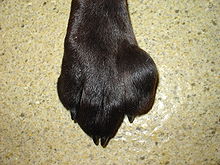
Common lump from cancer in a canine's foot.
The first sign of cancer in a canine is a new lump or the change in the size of an already existing lump. Very often the dog will get a runny nose, sometimes bloody, or will have difficulty urinating or even bloody urine. Vomiting and diarrhea, increased water intake, bad breath, excessive drooling, drainage in ears or even just limping are signs that a dog may in fact have some kind of cancer. Some breeds or more likely than others, for instance, Bernese Mountain Dogs, Boxers, Golden Retrievers, and Greyhounds are more likely than other breeds to get cancer. This does not mean that your Boxer who has recently started limping has cancer, these symptoms are often signs of other issues as well. However, as Rocky is a great example of, dogs just like humans can be incredible survivors as well. Just make sure to always be aware of your pet's behavior and be observant of anything strange going on with them, and please remember that their veterinarian is just a phone call away!