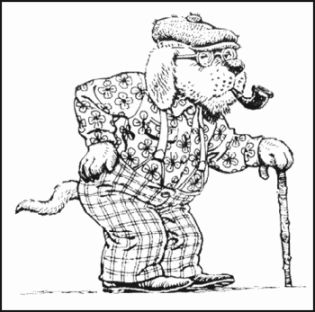
As I have mentioned briefly in several of my other posts, elderly dogs often go through the worst of times. Just like humans, age can truly take its toll on the elders of the canine world and this can be due to any number of problems. As the years go on, dogs can form illnesses they were not susceptible on young pups, full of health and life. However, instead of making this posting about any dozen of the diseases or physical ailments they may or may not form, I thought it might be a bit more interesting to talk about the behavioral changes they may undergo instead.
In my previous posting I brought up my fifteen year old dog, Angelica. She is a black lab and we have had her since she was just a few weeks old. Over the more recent years, she has developed that previously mentioned cyst, fat lumps on several parts of her body, as well as arthritis in her two bag legs. The cyst is untreatable and does not seem to bother her much at all, besides of course the unfortunate hearing loss. The fat lumps are just that, fatty lumps which have been checked and confirmed they are not cancerous at all. The arthritis has slowed her down greatly, and stairs were becoming more and more difficult for her however, a daily Aspirin seems to take care of this problem throughout the day. Though it would seem about time for my poor pooch to be put to sleep, we do not see much of a reason for this. She is honestly still a happy dog and enjoys playing with our eleven year old dog, Judo. The two get along for the most part but Angelica's mood swings often cause a bit of tension between the two. My mother has always says she will make sure to keep Ang around for as long as she seems happy. She does not appear to be in pain and lives an overall very happy life, still enjoying walks and times of play outside.
Getting off track a bit there, I would like to get back to the mood swings Angelica seems to go through sometimes. At times she will be licking Judo's face, showing utter affection towards her best pal but at other times, especially when food is at stake, she will snap at Judo. She will literally just bite at his face, never even making contact with him but definitely making it a threat to steer clear of her. He never pays much attention to her acts of aggression and just goes right along with what he was doing. There is a golden retriever puppy whom our neighbor brought home a few months ago and he loves to comes over and play all the time. Judo loves to have a playmate other than his old, grouchy one but Angelica could not be less pleased to have this pup around. She stands at the door and continuously barks until he goes away, and though she is never overly aggressive when she is outside with him, her unhappiness with his presence if very much apparent.
Wednesday, March 23, 2011

Monday, March 21, 2011
Skin Irritations Can Tell So Much
 It is rather common for dogs to develop cysts at some point in their life. At work we often have dog who have all different kinds of cysts. Usually older canines are the ones who tend to develop such problems and when these occur, very often older dogs are too old to undergo surgery to have the cyst removed. However, luckily they do always bother the dog. My dog actually has a growth in her ear and she does not seemed to be bother by it at all. She has lost all her hearing though but being fifteen years old, she is not nearly strong enough to go through a surgery.
 At work the other day we had a gold retriever come in with an extremely large cyst next to her tail. It was so large that it seemed as though it would be uncomfortable for her to even sit down but she seemed to be fine with it. The only thing was that we had to careful not to puncture it with a brush and just tried to steer clear of it altogether. If it had been punctured, she would have had to be rushed to the hospital and it was almost scary how easy it was to send this elderly dog to the hospital in critical condition.
The skin of a dog can tell an owner so much about their pooch. Even though a dog is active and seems completely healthy, sometimes growths and skin irritations such as cysts can make it clear that they are not in the best condition at all. Very often treatment for such problems is possible and must be taken advantage of right away. Often antibiotics can be prescribed to help clear up such irritations or growths, sometimes even just a change in diet can be helpful. For more serious cases, steroids may need to be used and in the worst case scenarios, surgery will be recommended. This is why regular check ups with a veterinarian are so vital to a dog's overall health and long life.
Subscribe to:
Comments (Atom)